
Cancelling GamStop the right way
There is one working route to cancel a GamStop registration. It runs through the scheme itself, it starts on gamstop.co.uk, and it is free to the person completing it. This chapter documents the process in the sequence the scheme uses and it treats the decision as a household-budget decision rather than an emotional one.
The design of the pause, the reason the period cannot be shortened once active, and the financial cost of a relapse are set out in the order a reader would want to see them before deciding what to do next.
Why this page exists, and what it will not do
This page exists because the top of the search results for a phrase like cancelling GamStop is a mixed environment in which the honest routes and the paid removal offerings sit side by side, and the reader has to make a judgement about which is which before they have finished reading the first paragraph.
NGC Insight is written from the current-account view of the topic, and the current-account view of the cancellation decision is that it is a household-budget event with visible consequences. The chapter is therefore ordered around the financial shape of the decision rather than the emotional shape, and every claim about a rule or a timing is anchored to the scheme's own words on gamstop.co.uk rather than to a third-party summary of them.
What this page will not do is explain how to shorten a live registration, present a workaround for the cool-off, recommend a paid removal service or discuss VPN configuration as an alternative route. None of these is a working route, and each of them ends at a bank counter with a decision the customer had not anticipated.
If a reader is on this page because a live GamStop registration is the last brake in a difficult week, the National Gambling Helpline number is 0808 8020 133 and the call is free from a UK phone, 24 hours a day, every day of the year.
The page assumes the reader is an adult entitled to a straight answer, but it does not pretend the answer is only technical. The financial cost of a relapse is real, and the page treats that cost as a first-order fact rather than a footnote to a procedure.
The correspondence we receive at the editor address is dominated by two categories, readers who wish they had understood the cool-off before their minimum period ended and readers who paid a commercial removal service in a difficult moment and then found the service could not deliver.
Both categories are avoidable with a small amount of information given at the right time, and the information is what this page tries to give.
02The official cancellation route, only you can do it
The route runs through the scheme itself in seven visible steps. Step one, sign in on gamstop.co.uk using the account the customer originally registered with, which requires the email address the customer used and the password set at that time. Step two, view the account status and confirm that the minimum period has ended, because the cancellation option does not become available until it has.
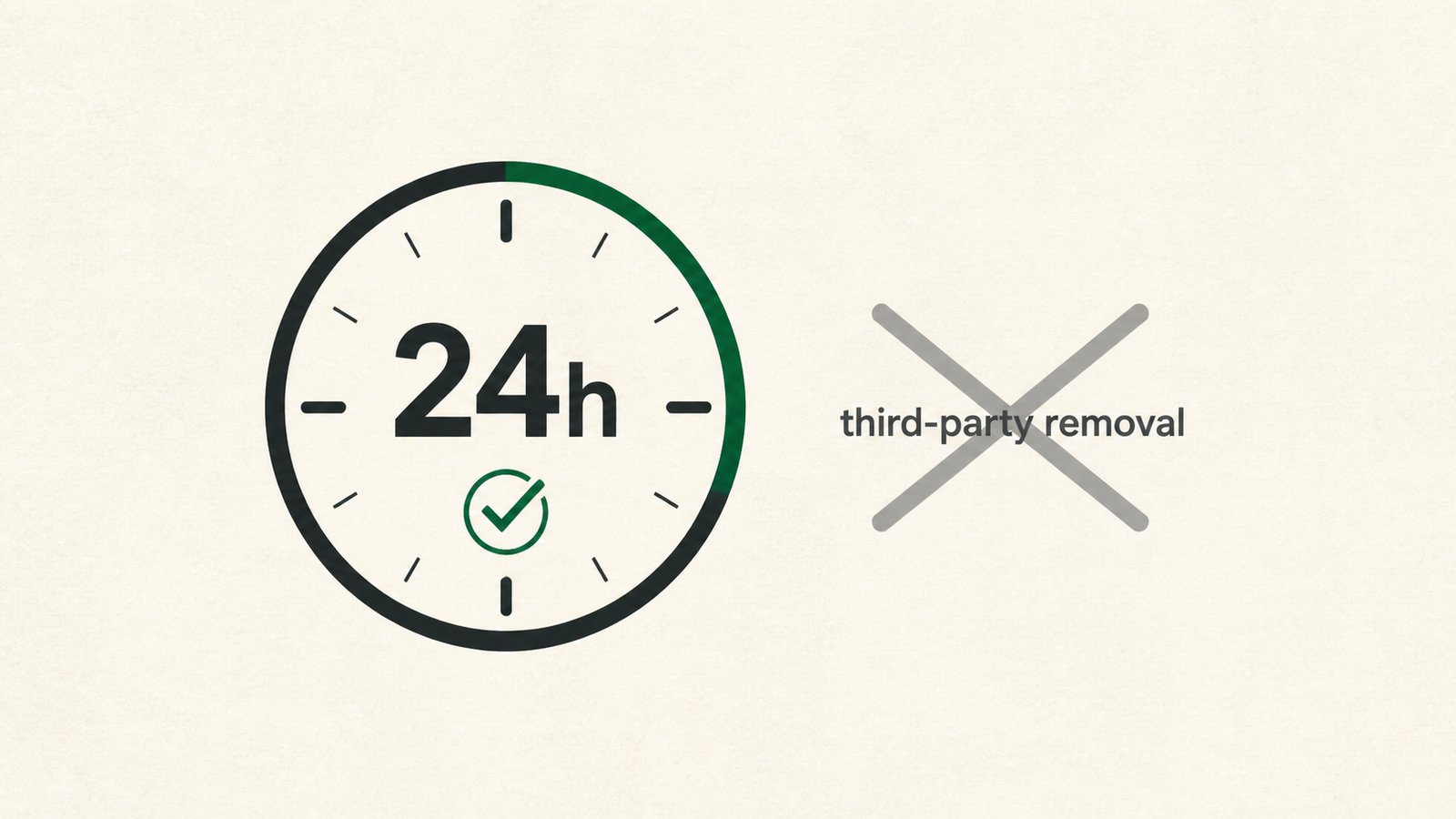
Step three, initiate the twenty-four-hour cool-off by clicking the option that appears on the account page once the period has elapsed. Step four, receive the confirmation email that the scheme sends automatically. Step five, wait the twenty-four hours. Step six, at the end of the twenty-four hours the block is technically lifted on the operator side, and every UKGC-licensed operator will now accept a fresh registration from the customer.
Step seven, review the card gambling switch and any bank-side controls the customer added during the minimum period and decide whether to leave them in place.
The point that catches many readers is that the block does not auto-lift at the moment the minimum period ends. GamStop is designed to require an active step from the customer, and that step is what starts the twenty-four-hour cool-off. A customer who does nothing at the end of the minimum period remains excluded, and if no action is taken for a further period the exclusion continues under an auto-extension mechanism described in section five below.
The active step is not a technicality, it is the design principle behind the whole scheme. The scheme is a voluntary consumer-finance safeguard, and the voluntary character of the return, like the voluntary character of the exclusion at the start, is what gives the mechanism its integrity.
The seven visible steps are documented in the scheme's own help pages, and the sequence has not changed materially in the last three years. What has changed is the surrounding infrastructure. The card gambling switches offered by the five UK banks named above are a piece of the return picture that did not exist when GamStop was first designed, and a customer completing the return should factor the switch into the return the way the return factors the switch into itself. Neither is a substitute for the other, and both together make a stronger frame than either alone.
A worked example
A customer registered for a one-year GamStop period on 4 September 2025. The registration is active from that date. Between 4 September 2025 and 4 September 2026 the block operates against every UKGC-licensed operator whether or not the customer takes any further step. On 4 September 2026 the minimum period ends.
If the customer signs in on 5 September, initiates the cancellation and passes the twenty-four-hour cool-off, the block is lifted on 6 September and any UKGC-licensed operator will now accept a fresh registration. If the customer takes no action, the exclusion continues, and if the inaction persists the seven-year auto-extension engages under the terms of the scheme.
03The minimum period rule and why it cannot be shortened
The GamStop scheme offers three minimum periods at registration, six months, one year and five years, and the choice is fixed at the moment of registration. Once the period is active it cannot be shortened. The rule applies without exception. It cannot be waived by an operator, by a paid removal service, by a data protection request or by any other external route, and it is enforced by the scheme itself rather than by an operator's discretion.
The reason it is enforced by the scheme is that the value of the mechanism sits in its refusal to negotiate with a moment. A decision taken during a clear month has to outrank a moment taken during a difficult evening, and the whole architecture of the block depends on that asymmetry being preserved.
The rule is closer in shape to a voluntary credit freeze than to a punishment. A credit freeze cannot be lifted with a single tap on a mobile app because the lift would defeat the freeze, and the same principle applies here. Every UK institution that touches an equivalent problem is designed around the same asymmetry.
The Debt Respite Scheme runs on a defined moratorium period that a debtor cannot shorten unilaterally. A regulated advice route through StepChange or Citizens Advice runs on a structured plan that does not collapse when a client asks for it to collapse in the middle.
The consumer-finance logic behind the minimum period rule is not unusual, it is the logic of every UK institution that offers a household a mechanism worth having. A reader who understands the rule as an act of care taken by the reader against a future version of the reader, rather than as a rule imposed from outside, is a reader who has understood why the rule exists at all.
The design does not ask the reader to accept a paternalistic constraint. It asks the reader to keep faith with the decision the reader made in a clearer moment, and it withholds the option to break that faith on impulse. The consumer-finance vocabulary for that arrangement is a precommitment device, and precommitment devices have measurable effects that improve outcomes in the population that uses them.
04The 24-hour cool-off once your period expires
The twenty-four-hour cool-off starts when the customer contacts GamStop after the minimum period has ended and requests that the exclusion be lifted. It is not a punishment layered on top of the exclusion, and it is not a delay caused by administration on the scheme's side.
The scheme is capable of lifting a block within seconds if the design required it to. The twenty-four-hour pause exists because a decision to return, taken in a moment that has crossed the calendar boundary but not yet crossed a full day of reflection, is a decision the scheme itself is not willing to complete on behalf of the customer without a designed interval between the request and the outcome.
What the customer receives during the cool-off is a written confirmation that the request has been logged, a clear statement of the moment at which the block will be lifted and a short recap of the resources available to a customer who has changed their mind.
The confirmation email is retained by the customer and can be produced later as evidence of the decision if it is ever needed for a bank conversation, a lender review or a family conversation. At the end of the twenty-four hours the block is technically lifted on the operator side, but the customer's account with any specific operator remains closed until the customer opens a fresh account.
The cool-off does not resume an old account, it lifts the scheme-wide block that was preventing the opening of any UKGC-licensed account. A customer who changes their mind during the twenty-four hours can simply take no further action, in which case the block continues without any further paperwork on either side.
Points worth knowing
- The minimum period cannot be shortened once active, regardless of who asks or what fee is offered
- The block does not auto-lift at expiry. The customer has to contact GamStop and pass a twenty-four-hour cool-off
- Inaction after expiry engages a further seven-year exclusion under the scheme's auto-extension
The seven-year auto-extension for inaction
If a customer takes no action after the minimum period ends, the exclusion continues for a further seven years under the scheme's auto-extension. The rule is documented on gamstop.co.uk and applies automatically without any correspondence from the scheme other than the periodic reminders sent to the email address the customer registered with.
The auto-extension is not a trap. It is a safety-net feature that preserves the block for customers who have chosen not to take an active step to remove it, and it exists because a return that requires a positive action from the customer is the return the scheme is willing to complete. A return that would happen because the calendar rolled over is not the return the scheme is designed to enable.
The consumer-finance implication is that the customer who is uncertain at the end of the minimum period retains the value of the block by doing nothing. A customer who is sure of the decision to return can take the active step, pass the cool-off and see the block lifted.
A customer who is unsure keeps the block by default. That is the correct default for a mechanism whose purpose is harm reduction. A customer who has taken no action after seven years faces a fresh decision at that point, and every letter the scheme sends in the intervening period signposts the routes available to a customer who wants to review the position, the National Gambling Helpline being at the top of that list.
A worked example
A customer registered for a five-year GamStop period on 1 January 2021. The minimum period ends on 1 January 2026. The customer receives an email from the scheme in the days around expiry, explaining that the block does not auto-lift and setting out the route to request its removal if that is what the customer wants.
The customer does not respond, and takes no active step for the following ninety days. On 1 April 2026, under the auto-extension, the exclusion continues for a further seven years and will end on 1 January 2033 unless a positive step is taken at that point. The extension is not a penalty, it is the default the scheme applies to inaction.
06Paid removal services, why they fail and cost you
Every commercial removal offering advertised online charges money for one of three things. It charges for a step GamStop performs for free, in which case the customer has paid for nothing they could not have obtained themselves. It charges for a step no third party can perform at all, because the GamStop database is not open to intermediaries and the scheme is bound not to shorten a live period.
Or it charges for a step whose promised route would breach the Data Protection Act 2018 if it worked, in which case the fee is a payment for a proposition that is either dishonest or unlawful. There is no fourth category. Payment to a removal service does not produce a shortened period, does not produce a lifted block and does not produce a route around the scheme.
The commercial removal market is a category consumer-protection regulators watch, and the Advertising Standards Authority has ruled against removal claims in this vertical on multiple occasions over the last three years. From a consumer-finance point of view the more useful framing is the one where the fee itself is a downstream cost of the pattern that led to the original registration.
A person who is paying a removal service to shorten a self-exclusion is spending money to defeat a decision they made in a clearer moment, and the fee has the same shape as the deposit it is trying to enable. If the money is going to move regardless, it is worth asking whether it might move instead to the National Gambling Helpline conversation, which is free, and to a StepChange or Citizens Advice appointment, which is also free, and which will produce a real result rather than a promise.
The removal-service market advertises through the same search-engine channels the legitimate scheme uses, and the paid placements can outrank the scheme itself on a search for the phrase most likely to bring a distressed reader to the top of the results. A reader who lands on a paid page in a difficult moment is a reader for whom the fee is a friction the paid page depends on.
NGC Insight has published the correspondence on this pattern in the pages we have written on the topic, and the pattern is stable across the six months of records we hold. The route that saves money is the route that does not require any money to be paid at all.
Safer alternatives while you wait it out
A minimum period that cannot be shortened is not an empty period. It is a defined window in which the household budget can be rebuilt and the mechanisms that would catch a future lapse can be put in place. The most useful step during that window is to activate the card gambling switch offered by HSBC, Monzo, Starling, Lloyds or Barclays, because the switch will continue to work after GamStop is lifted, and it will catch offshore transactions in a way GamStop does not.
A second step is to open a savings account with a separate credit reference footprint, which changes the shape of the current-account statement a lender would see and creates a positive record over the same period.
A third step is to review the standing rules on the current account, and where a joint account is in place to have the conversation with the partner about what oversight looks like on the return leg. Standing orders that move a defined sum into a savings account on payday are a lightweight version of the pay-yourself-first principle a household finance adviser would recommend, and the credit union sector has products that make the same principle available at scale.
A fourth step is to keep a written record of the decision to register and the reasoning at the time, in a note or a letter to a future version of the self, because the decision is often clearer at the moment it is taken than at the moment the calendar rolls over.
A fifth step, which is easy to underestimate, is to talk with a family member, a partner or a close friend about the position, because a decision that lives inside the head of one person is a decision that a difficult evening can undo without anyone noticing until the statement arrives.
The mechanisms above are lightweight because the decision to register was already the heavy piece. What the minimum period offers is the space in which to make the lighter pieces work.
08Getting help first: GamCare and NHS gambling clinics
The National Gambling Helpline on 0808 8020 133 is free to the caller, confidential in the legal sense that matters when a partner, an employer or a lender might otherwise learn about the call, and open every hour of every day of the year including public holidays.
The advisers who answer are trained to talk about the money side of the decision as directly as the emotional side, and a call that starts with a card statement, an overdraft alert or a partner's question about a joint account is treated as seriously as one that starts with a feeling.
A first call is often shorter than a caller expects and rarely feels like the conversation the caller had rehearsed on the way to the phone.
NHS specialist gambling clinics take referrals in every English region and through the equivalent devolved routes in Scotland, Wales and Northern Ireland. Referral can be self-initiated, GP-initiated or via a GamCare adviser, and the treatment offered ranges from a structured cognitive behavioural programme to residential care in the small minority of cases that require it.
A referral does not sit on a public record, does not affect an insurance premium, does not appear on a credit file and does not affect a mortgage or a job reference. The clinic route is worth mentioning to a GP even if the customer has not decided whether to take it up, because the conversation itself is often the step that makes the decision possible.
Every route on this page is designed to be free at the point of contact and confidential in the ways that matter. The debt-advice route runs alongside the clinical route, and StepChange, National Debtline and Citizens Advice each offer free structured debt advice regulated by the Financial Conduct Authority.
The Debt Respite Scheme, sometimes called breathing space, pauses enforcement action and interest on qualifying debts for sixty days while a plan is worked up, and the mental health crisis version runs for the duration of the crisis treatment. If a reader takes a single number from this chapter, it is 0808 8020 133.
If a reader takes a second number, it is the StepChange freephone route. If a reader takes a third, it is the National Debtline number. Every number is free, every number is confidential in the ways that matter, and every number connects to a person whose job is to help.
Read next
- What GamStop is and how it actually works
- Legality for UK players and where UKGC remit ends
- Consumer-protection risks of offshore sites
- KYC, AML and payment realities for UK players
- Help, support and where to talk to someone today
Sources and verification
Every step in the cancellation sequence has been checked against the scheme's own words on gamstop.co.uk, including the twenty-four-hour cool-off, the minimum-period rule and the auto-extension mechanism. Last checked 5 August 2026.
Frequently asked questions
Can I shorten a GamStop registration once it is active
No. Once a GamStop registration is active the minimum period of six months, one year or five years cannot be shortened. The rule applies to every registration on the scheme and cannot be waived by an operator, an intermediary or a paid removal service. The design is deliberate.
A decision taken during a clear month is intended to outrank a moment taken during a difficult evening, which is the same logic that shapes a voluntary credit freeze or a debt breathing-space application.
What does the twenty-four-hour cool-off actually do
The twenty-four-hour cool-off runs from the moment a person actively contacts GamStop after the minimum period has ended to request that the exclusion be lifted. The block does not auto-lift at the expiry date. During the cool-off the customer receives written confirmation, and at the end of the twenty-four hours the block is technically lifted on the operator side.
The pause exists so that the decision to return can be reviewed against a full day of reflection rather than the moment the calendar rolled over.
Why do third-party removal services not work
Every commercial removal offering advertised online charges money for one of three things. A step GamStop performs for free through the account the customer originally registered with. A step no third party can perform at all, because the database is not open to intermediaries. Or a step whose promised route would breach the Data Protection Act 2018 if it worked.
The paid services do not have access to the GamStop database and cannot shorten a period that the scheme itself is bound not to shorten.
What is the financial cost of relapse if the block is lifted early
The financial cost of a relapse is disproportionate to the sum that first re-entered play. Correspondence received by NGC Insight documents the pattern in which a first return deposit of a low three-figure sum is followed within thirty days by a debt profile that includes an overdraft at the limit, a credit card balance rising against the account and, in a significant minority of cases, a personal loan opened in the second month.
Recovery is possible through StepChange, Citizens Advice and the Debt Respite Scheme, but the debt taken on during the relapse period does not disappear when the pattern is recognised.
Can I re-register with GamStop straight after I have cancelled
Yes. A fresh GamStop registration can be opened immediately after a previous exclusion has been lifted, including on the same day. Re-registration follows the same route as a first registration and carries the same choice between the six month, one year and five year minimum periods. Every UKGC-licensed operator receives the updated GamStop status and applies the block from the moment the registration is confirmed.
Talk to someone today
The National Gambling Helpline is free, confidential, and open 24 hours a day, seven days a week.