
Where your money is exposed offshore
This is the chapter to read before any pound leaves a UK current account for an offshore cashier. It sets out what a household actually loses when the operator sits outside UKGC. No mandatory fund segregation, no UKGC-approved Alternative Dispute Resolution route, chargeback rights that collapse against a foreign merchant defence and civil recovery costs that dwarf almost every deposit a UK adult would realistically make.
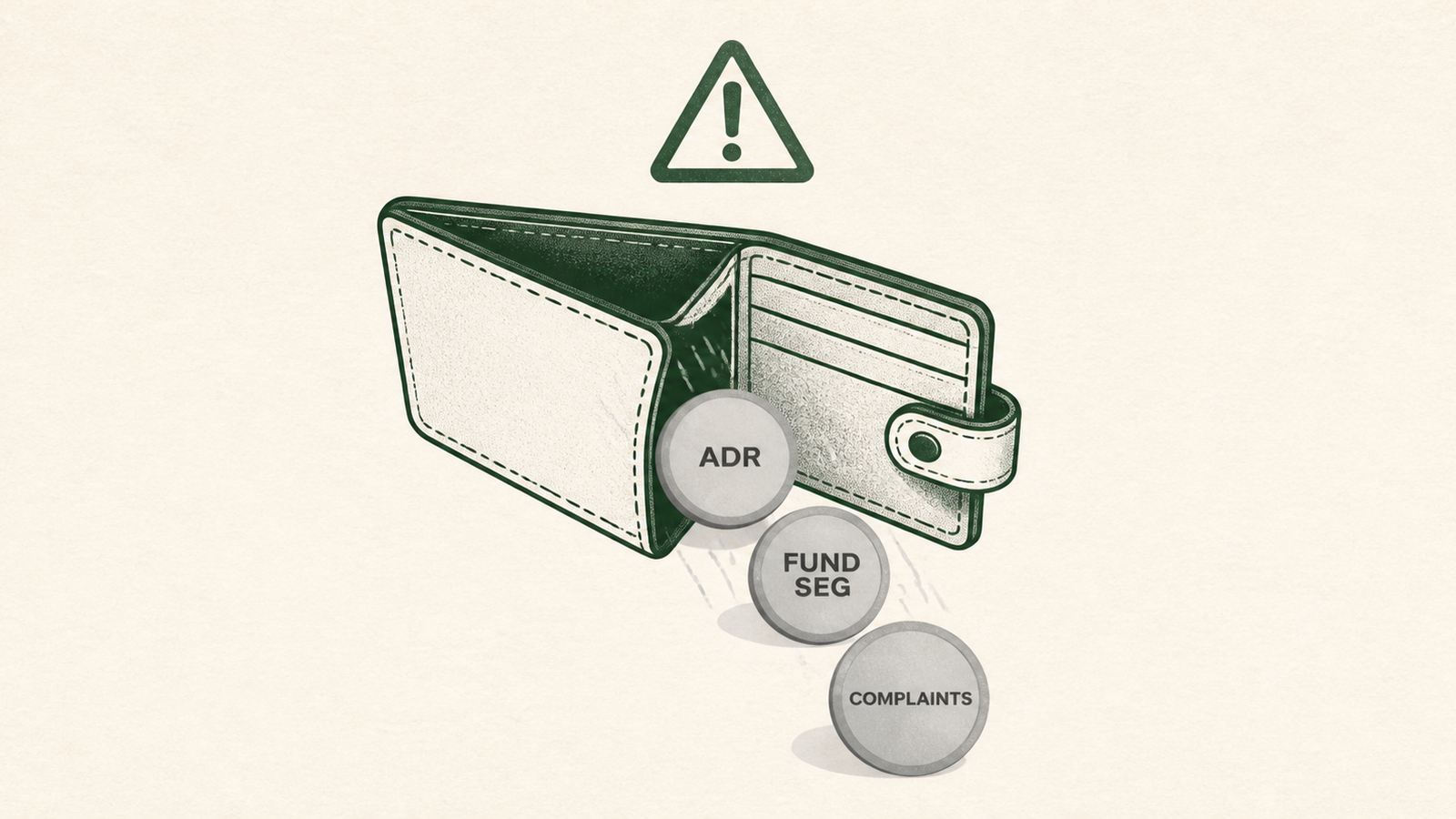
No UKGC oversight, what that means for your funds
UKGC oversight of a licensee is not a badge on a website. It is a set of hard obligations the licensee owes as a condition of being permitted to trade in the UK, and it is the reason a UK adult can rely on a specific list of protections when the operator sits inside the licensed estate.
The Commission requires a licensee to segregate customer funds according to a stated protection level, to hold a UKGC-approved Alternative Dispute Resolution contract, to comply with anti-money-laundering obligations that overlap with the Money Laundering Regulations 2017, to run technical certification of its random number generation and to co-operate with the Commission's own supervision on demand.
Every one of those obligations lifts away the moment the customer transacts with an operator UKGC does not license. Day to day, that absence shows up as a series of small differences that a household only notices at the moment a dispute arises, which by then is late.
The consumer-finance reader should picture the difference as a household budget item that is either insured or uninsured. A UKGC-licensed cashier is not a guarantee of a winning session, and no regulator can turn a losing bet into a refunded one. What it does guarantee is that if the operator fails, mishandles a withdrawal or breaches its own terms, a specific list of UK institutions has a specific list of powers to intervene.
An offshore cashier is uninsured in exactly the sense that no equivalent list applies. The household that experiences a routine loss at either operator experiences the same outcome on the day of the loss. The household that experiences a non-routine event, from a KYC hold that stretches for three weeks to an operator that goes offline entirely, experiences two very different outcomes downstream.
That downstream picture is what this chapter documents, and it is what a household loses at the moment the operator sits outside UKGC.
02No guarantee your funds are kept separate
Fund segregation is the requirement that an operator holds customer balances in an account that sits outside its own trading balance sheet, so that if the operator fails, the customer balances are not available to the operator's general creditors. UKGC classifies licensees under three protection levels, basic, medium and high, and each requires a stated segregation arrangement, from a simple designated account through to a trust with a written declaration in the customer's favour.
That framework is not a global norm. Curacao's licensing regime does not impose the same rule, Malta's does not use the same taxonomy and Anjouan is silent on the point in the terms a UK reader can inspect. The consumer-finance reading is that a household transferring £250 to an offshore cashier is depositing money into an operator's trading balance sheet rather than into a ring-fenced account it can recover on failure.
The practical impact of an unsegregated balance is invisible until it matters. Under normal operating conditions the customer withdraws the balance on request and the segregation question does not arise. Under stressed operating conditions, from a solvency event at the operator to a licence suspension in the operator's jurisdiction, the balance ranks alongside the operator's other liabilities in a foreign insolvency estate.
A UK reader cannot bring a UK insolvency remedy against a foreign operator, and the recovery of an unsegregated balance in a foreign insolvency proceeding is a route that costs more to run than almost any household deposit is worth. Read that arithmetic before the deposit rather than after, because the moment the operator's balance sheet becomes a distressed one, the deposit is already inside the wrong pool.
A worked example
Suppose a UK household deposits £500 across three sessions at an offshore operator with an unclear segregation position. The customer wins £900, requests a withdrawal, and receives a message that the operator is undergoing a review. Two weeks later the operator's website is down and the licensing jurisdiction's regulator announces an intervention.
If the £900 sat in a segregated trust account, a receiver appointed under the jurisdiction's rules would distribute the balance back to customers as trust property. If it sat in the operator's trading account, the customer joins the general creditor queue behind the operator's tax liabilities, its supplier invoices and its salaried staff.
The UK equivalent estate for a UKGC-licensed operator would produce a very different outcome. The offshore estate produces a distribution rate that is often close to zero once the receiver's own fees are settled from the estate first.
03No mandatory ADR if a payment dispute arises
Alternative Dispute Resolution schemes approved by UKGC hear complaints against UKGC licensees under contracts the licensees are required to hold as a condition of their licence. The system is designed so that a customer with a dispute has a free, independent, English-language route to a binding decision after the operator's own complaints process has been exhausted.
That system does not extend to operators UKGC does not license. There is no UKGC-approved ADR body against a Curacao-licensed operator, no substitute UK forum that hears the case in the ADR's place, and no reciprocal enforcement arrangement that turns an offshore internal decision into a UK court judgment. An operator's own internal complaints handling is not a substitute, because the operator is the counterparty rather than the arbitrator.
Some offshore jurisdictions require licensees to appoint an internal dispute-handling function or to publish a link to a jurisdictional dispute body. Those routes are not equivalent to a UKGC-approved ADR because they lack UK enforcement, they lack English-language procedural fairness in most cases and they lack the independence a UKGC-approved body demonstrates through its own supervision.
The Financial Ombudsman Service does not fill the gap either, because it hears complaints against Financial Conduct Authority regulated firms and the operator is not one of them. What that leaves the customer with is the operator's own internal process, followed by whatever civil route the customer is willing to fund in the operator's jurisdiction.
The distance between those two options and a UKGC-approved ADR route is enormous, and the fee-cost side of the second option makes it impractical for household sums.
04Offshore licensing tiers: MGA, Gibraltar, Curacao LOK 2024, Anjouan
The offshore licensing landscape is not homogeneous, and it is worth distinguishing four categories that a UK reader is likely to see cited in operator terms and conditions. Malta's regulator, the Malta Gaming Authority, imposes a comparatively stringent regime by international comparison, including a formal complaints route and an operator supervision framework that resembles UKGC in structure though not in enforceability from a UK consumer's perspective.
Gibraltar's regulator historically supervised operators that also served the UK market under UKGC licences held simultaneously, and its regime remains among the more mature. Curacao, following the Landsverordening op de Kansspelen of 24 December 2024, consolidated its supervision under the Curacao Gaming Authority and closed the master-licence sub-licensing gap that previously allowed operators to shelter under a master's supervision without direct accountability.
Anjouan sits at the light-touch end of the spectrum, with a licensing framework that a UK reader would struggle to compare in structure to any of the above.
The consumer-finance reading of that landscape is that operator jurisdiction is a first-order variable in the risk assessment a household should perform before any deposit. It is not the only variable, and a Malta licence is not a UKGC licence, but the differences between the four categories are large enough to produce very different outcomes on the same downstream event.
A household considering an offshore cashier is, whether or not it realises the point, choosing a supervisory framework alongside choosing a gambling product. The absence of a UKGC framework is one loss, and the choice of an inferior framework in its place is a second one.
Reading the operator's licence position on a fresh page of the terms and conditions rather than in the footer of the marketing pages is the first step in that assessment, because the footer version rarely tells the full jurisdictional picture.
Points worth knowing
- Fund segregation is a UKGC licence condition rather than a global norm across offshore jurisdictions
- No UKGC-approved ADR route exists against an operator UKGC does not license
- The Curacao LOK reform of 24 December 2024 consolidated supervision but did not import UKGC-equivalent consumer protection
- Chargeback rights survive in theory on misdescribed deposits, and collapse in practice against foreign merchant defence
How the Curacao LOK reform shifted risk in December 2024
The Landsverordening op de Kansspelen came into force on 24 December 2024 and replaced the earlier master-licence structure with a single-regulator regime under the Curacao Gaming Authority. Under the previous system a small number of master-licence holders sub-licensed operators the master could not effectively supervise, which produced a supervisory gap that Curacao's own reform documents explicitly acknowledged and closed.
The reform gives direct accountability of licensees to the CGA, tightens some ongoing reporting obligations and formalises technical certification requirements. For readers looking at Curacao as an internal problem, the reform is a real improvement. For readers looking at Curacao from a UK consumer position, the reform did not close the gap that matters to a UK household, which is the absence of UKGC-equivalent consumer protection standards.
What the reform did not do is import a fund segregation obligation of the UKGC kind, did not open an English-language ADR route that a UK customer can approach, did not codify reciprocal enforcement against a UK court judgment and did not introduce a vulnerable-customer definition that matches UKGC's own.
Reading the LOK expecting those outcomes is the way to reach the wrong conclusion about how a dispute would resolve. The reform improved an internal Curacao problem without changing the external UK problem, and the consumer-finance takeaway is that a UK household should read the Curacao reform as a supervisory tightening on the licensee's side rather than as a protective loosening on the customer's side.
The relevant question is what recovers a deposit if something goes wrong, and the Curacao reform does not change the answer to that question.
A worked example
Consider a UK adult who reads a news summary describing the LOK reform as bringing Curacao closer to UK standards. The adult concludes that a Curacao-licensed cashier now offers a comparable protection level to a UKGC-licensed one. Six weeks later the adult experiences a KYC hold on a £700 withdrawal and looks for the ADR route the news summary implied.
There is no such route, because the reform did not create one. The customer's actual options remain the operator's own complaints process, followed by a civil route in Curacao at fees measured in thousands rather than in tens. The reform did not lie to the customer, but the news summary did, because it treated the reform as a UK-facing consumer measure when its scope was a domestic Curacao supervisory measure. Reading the reform in the terms Curacao itself uses is what avoids that misreading.
06Where payments fail and why banks block them more
Card issuers apply merchant category code 7995 to gambling merchants globally, and the code triggers a set of anti-money-laundering monitoring rules under the Money Laundering Regulations 2017 that a domestic retail purchase does not encounter. When the operator sits abroad, cross-border interchange rules add a second layer, the operator's acquirer adds a third and the bank's own suspicious activity report threshold sits behind all of them.
The five UK banks with voluntary card gambling switches, HSBC, Monzo, Starling, Lloyds and Barclays, apply the switch at the issuer level with a cool-off reversal that ranges from two to seven working days depending on the bank. Even without the switch turned on, the layered monitoring produces a higher refusal probability on 7995 activity than on any comparable domestic authorisation, and the trend line is toward tighter enforcement rather than looser.
The consumer-finance impact of that trend is that a refused deposit is often the first visible edge of a check that has already run three or four times behind the scenes. A repeated pattern of refused deposits produces exactly the paperwork trail an anti-money-laundering officer at the card issuer wants to see, and the trail feeds into the bank's decision on whether to file a suspicious activity report with the National Crime Agency.
From the customer's perspective the outcome is a card that stops working at the operator's cashier, followed by a call from the fraud line, followed in some cases by a partial or full account restriction while the bank runs enhanced due diligence. Reading that trail as a hostile intervention misses the point.
The trail is a piece of consumer-finance infrastructure that the customer's own bank is required to run, and the deposit that triggered it sits at the far end of a chain the customer does not usually see. Where the customer's account is restricted, the resolution route is a request for a review through the bank's own complaints process, and where that is unsuccessful, escalation to the Financial Ombudsman Service.
Neither route touches the underlying gambling transaction, because neither institution has jurisdiction over the operator. Both touch only the bank's own conduct in applying the rules the regulations require it to apply.
Where your uploaded KYC documents actually go
An offshore operator's Know Your Customer process typically requires a passport or driving licence image, a recent utility bill or bank statement, and in some cases a live selfie for biometric matching. The documents pass to the operator's own systems and, in most implementations, on to a third-party verification provider that runs the identity match.
The data protection regime that governs the storage and processing of those documents is the regime of the operator's jurisdiction, not the UK General Data Protection Regulation as retained in UK law under the Data Protection Act 2018. A UK subject access request against a UK data controller is a workable mechanism.
A UK subject access request against a Curacao data controller is a mechanism the customer can send but not enforce, and the response depends on the operator's willingness to engage rather than on a UK regulator's authority to require the response.
The consumer-finance angle on data risk is that a set of identity documents pooled across a small number of offshore operators represents a concentration risk the customer has not asked to bear. A breach at one operator can expose documents that the customer originally uploaded in an unrelated session at another operator sharing the same third-party verification provider.
The Information Commissioner's Office has UK jurisdiction over UK data controllers but has no route to compel a foreign controller's cooperation on the same terms. The customer's protection is therefore weaker than the domestic norm suggests, and the weakness is not visible at the moment of upload.
It becomes visible only if a breach is later reported, which offshore operators are not always required to do to the customer in the same timelines the UK regime requires.
08Protecting your money if you have already deposited
If a deposit has already been made at an offshore operator, the useful steps run in a defined order. First, log in and initiate a withdrawal of the available balance in full. Second, take a screenshot of the withdrawal request confirmation and the account statement inside the operator.
Third, record the exact card statement descriptor as it appears on your own bank statement, because that descriptor is the reference point every downstream route will use. Fourth, if a withdrawal is refused or held for a KYC reason, submit whatever the operator asks and keep a record of what has been submitted and when.
Fifth, if the withdrawal fails after documents have been submitted, raise a chargeback with your card issuer on the ground that appears strongest, which for a misdescribed deposit is service not rendered and for a hold on winnings is a narrower path. Sixth, contact your bank's fraud line separately for guidance on transaction monitoring implications.
Beyond the recovery steps, the harm-reduction side of practical action is worth naming plainly. Turn on the card gambling switch at your own bank if it is not already on. Consider a GamStop registration for the length the current situation warrants, remembering the minimum period cannot be shortened once active.
Speak to the National Gambling Helpline on 0808 8020 133 for a conversation that treats the money side and the wellbeing side as one conversation rather than two. Consider a StepChange contact if the deposits have produced a debt position that needs breathing space, and a Citizens Advice contact if benefit implications are in play.
None of those steps is legal advice, and none of them substitutes for a professional adviser where the sums warrant one. Each of them is a UK institution built to catch exactly this shape of situation, and each of them is free at the point of contact.
A household that acts on this list on the same day rarely regrets acting quickly, and a household that hesitates almost always regrets the hesitation once the operator's dormancy clock starts running or the card issuer's monitoring pattern hardens into a formal review. The steps are boring by design, because boring is what a consumer-finance safety net looks like when it works, and boring is what a household usually wants at the moment none of the more interesting options is available.
Read next
- What GamStop is and how it actually works
- Legality for UK players and where UKGC remit ends
- KYC, AML and payment realities for UK players
- Cancelling GamStop the right way
- Help, support and where to talk to someone today
Sources and verification
Fund segregation levels, ADR requirements and licence-condition detail are verified against the Commission's own licence-condition guidance on gamblingcommission.gov.uk, cross-checked against the Curacao LOK reform materials and the Money Laundering Regulations 2017 as currently consolidated. Last checked 5 August 2026.
Frequently asked questions
If an offshore operator holds my balance and refuses a withdrawal, can I recover it
There is no UK institution with authority to order the operator to release the balance. Card-scheme chargeback may work on a deposit that has been misdescribed, but it does not recover winnings. The remaining routes are civil claim in the operator's jurisdiction and, where a suspicious activity report is warranted, engagement with the National Crime Agency. In practice the recovery cost is disproportionate to almost every deposit a UK household would ever make.
Does an offshore operator have to keep my deposit off its own balance sheet
Fund segregation is a UKGC licence condition rather than a global norm. An operator outside UKGC's remit is not bound to hold customer balances in a separate trust or client-money account, and the licensing jurisdiction may not impose an equivalent rule. If the operator fails, the customer's balance may rank alongside general creditors rather than sit outside the estate, which is a materially different outcome from the UK domestic norm.
Will my card scheme reverse an offshore gambling transaction on chargeback
A chargeback for goods not as described or services not provided may be raised, but the reversal succeeds only when the merchant either accepts the reversal or fails to defend it under the scheme rules. Offshore operators frequently defend by pointing to a completed play session, which the scheme treats as service rendered.
The chargeback path is therefore a partial route in theory and a narrow one in practice, especially for winnings rather than misdescribed deposits.
Did the Curacao LOK reform of December 2024 add UKGC-equivalent protection
No. The Landsverordening op de Kansspelen that came into force on 24 December 2024 consolidated licensing under the Curacao Gaming Authority and closed the master-licence sub-licensing gap. It did not introduce a fund segregation obligation of the UKGC kind, did not open a UK-approachable ADR route and did not import reciprocal enforcement against a UK consumer complaint. The reform improved an internal Curacao problem without changing the external UK position.
What actually happens to a dormant balance at an offshore operator
The operator's terms and conditions specify a dormancy period after which the operator treats the balance as forfeited or applies an administrative fee that erodes the balance to zero. The period varies but frequently sits between six and twelve months of inactivity. A UK reader can interrupt the clock by logging in or by requesting a withdrawal within the period, but the clock resumes on inactivity, and no UK institution can extend the period on the customer's behalf.
Talk to someone today
The National Gambling Helpline is free, confidential, and open 24 hours a day, seven days a week.